

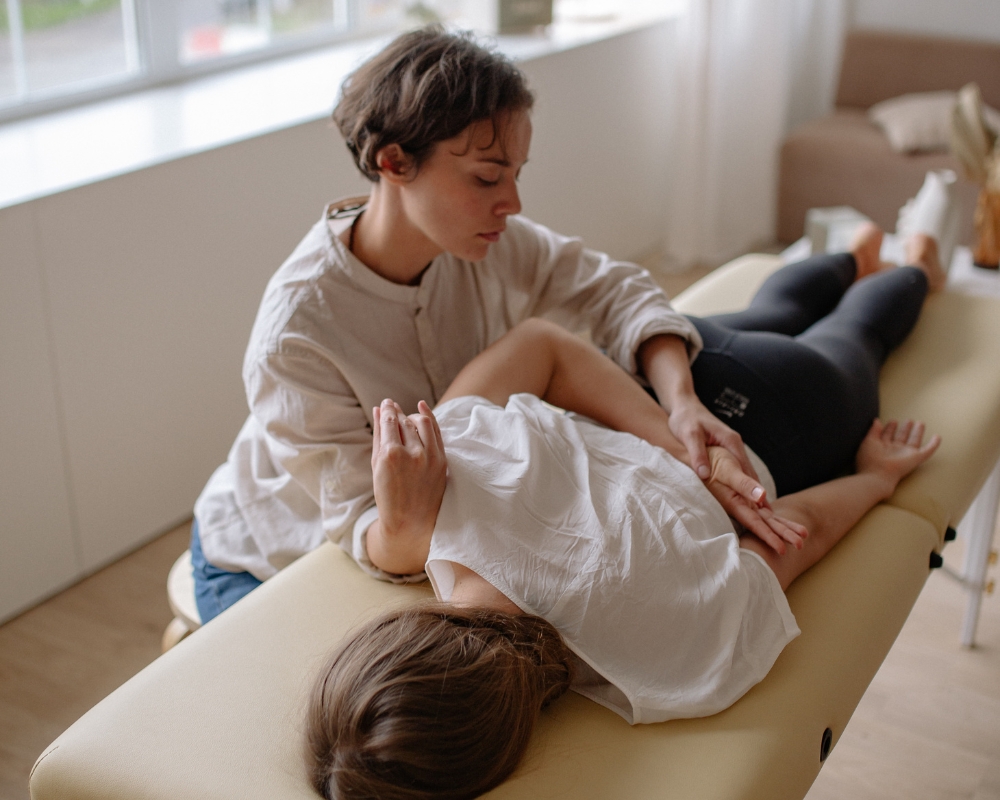

Perinatal osteopathy supports women and babies at every stage of motherhood: before, during and after birth. Gentle and natural, this manual approach aims to restore the body’s balance and promote overall well-being. Let’s take a look at its principles, areas of application and what happens during a session.
What is perinatal osteopathy?
Perinatal osteopathy, like osteopathy in general, is a form of manual medicine that treats the patient as a whole.
It involves four types of therapeutic care:
- Infertility problems
- Support during pregnancy
- Care for the baby from the first days of life
- Postpartum
Osteopaths, with their in-depth knowledge of human anatomy and physiology, focus on the relationship between structure and function. They aim to restore proper mobility to each part of the body and stimulate its ability to heal itself. The practice is as gentle as possible and uses safe and effective techniques.
What to expect during a session
An osteopathy session always begins with a verbal exchange with the patient in order to obtain key information about them and the reason for their visit. This is followed by a palpatory examination to identify any areas of tension. Finally, the osteopath proceeds with treatment, choosing techniques appropriate to the mobility issues encountered.
Osteopathy and infertility: comprehensive support
The desire to have a baby can sometimes be a more complicated journey for some people. With their holistic approach and understanding of the link between structure and function, osteopaths are key players in this endeavour.
In order to become pregnant, it is important that all the structures involved in the conception process function optimally (ovaries, uterus, hormonal system, vascular system, but also the mobility of the pelvis, lumbar spine, coccyx, etc.).
This is to allow the future baby to implant and develop in the most optimal conditions possible.
The osteopath will therefore check, among other things, that all the structures involved are mobile and that the small pelvis is well supplied with blood.
Please note
Osteopathic treatment for fertility problems is not intended to replace existing medical procedures, of course.
It is an effective and meaningful complementary therapy due to its vision and interpretation of the human body and human physiology. For more information, please consult your osteopath.
Osteopathy and pregnancy: caring support
Pregnancy is a wonderful time. It is also a time of great adaptation and change in the mother-to-be’s body. The belly grows rounder and the baby gets bigger and bigger. The mother’s entire body adapts, particularly the pelvis, lumbar spine, thoracolumbar junction, etc. Tension and pain may arise, and osteopathy is an effective way to relieve them.
Why consult an osteopath?
- Standard pregnancy monitoring – 13/23/33 weeks
- Ligament or joint tension
- Digestive problems (nausea, reflux, etc.)
- Sciatica in pregnant women
- Intrauterine malposition (baby too low or in breech position)
- Preparation for childbirth
How does the session work?
Using techniques adapted to pregnant women, the osteopath will treat your body very gently. They will outline the objectives of the day’s session and answer any questions or concerns you may have.
Personalised support throughout pregnancy
The osteopath offers support throughout pregnancy, allowing them to monitor the patient. This involves three follow-up sessions to prevent any tension that could quickly become debilitating. The osteopath will adapt to the changes in the mother’s body and work with a holistic approach to mother and baby.

